
Selected publications
Foundational Research in Pattern Recognition, Computational Biology, Cellular Automata, Supercomputer Architectures, and Gaming in Collective Intelligence.
PhD. Pattern Recognition. Computational Biology.
An initial interest in AI arose while writing a dissertation on visual pattern recognition for robots. A text-reading system was developed using a phototelegraphic device and a PDP-8 computer. Later I studied biophysics and neuroscience, lectured, and led the development of neurocomputers within the Mathematical Biology group at St. Petersburg University (USSR).
Starting in 1985, I developed the theory of generalized cellular automata (CA) and its application to modeling biological systems, including various types of neural networks. In 1986, as a result of research into CA models, he created a new abstract game called CTOR (Cellular Torus); it gained popularity in Russia starting in the late 1990s and saw a production run of 100,000 copies.
Supercomputing. Cellular Automata
I led the development of the "Locon" supercomputer—based on 16,000 processors with a parallel architecture—at a design bureau (LKTB, Leningrad, USSR, with the support of I.V. Berg. In the photo, it's me and Berg.). Details of this development were published in the article "Avionics at the Turn of the Millennium" in the journal *Mir Avioniki* (Issues 1–2, 2000, pp. 45–49). I am the author of scientific and popular science articles, as well as the monograph *Mathematical Modeling of Biosystems* (St. Petersburg State University, former LGU 1989).
Gaming in Collective Intelligence.
I currently reside in Canada, where I continue to develop the mechanics of the CTOR game and explore their application across various fields—from sports to science and education. In 2016, I gave a TEDx talk titled "How to Measure Collective Thinking?" This area of research—specifically the collective behavior of agents—is what interests me most today, and it represents one of the key challenges in developing AI-agent-based systems. We are confident that our game mechanics model will help solve this problem. We are open to collaboration, so please feel free to reach out.
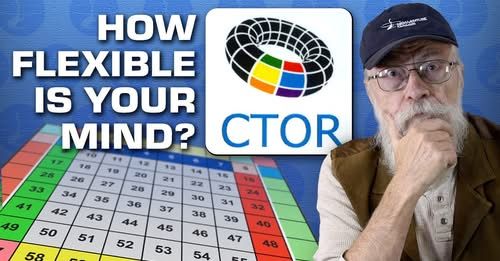
Game's history and full rules.
Invented by Dr. Vladmir Bronnikov (a.k.a. "Dr. Bronn"), the CTOR game board has been designed to represent a 3-dimensional playing surface - the Torus. (Torus is the scientific name for the shape of a donut).
New Venture Game (USA)
Watch the full video here:
CTOR! A fascinating abstract strategy game from Russia that "folds space". - YouTube
AI vs AI * Team vs Team * AI vs Human

Master class for the Toronto University (UofT). Gaming platform tournaments between AI agents are developed. A pilot project where AI bots play against each other.
Master class for the Toronto University (UofT). Gaming platform tournaments between AI agents are developed. A pilot project where AI bots play against each other.
Master class for the Toronto University (UofT). Gaming platform tournaments between AI agents are developed. A pilot project where AI bots play against each other.
School course: "Creative and Memory" at Discovery Academy. Canada. Testing collective intelligence in teams of three players.
Master class for the Toronto University (UofT). Gaming platform tournaments between AI agents are developed. A pilot project where AI bots play against each other.
Master class for the Toronto University (UofT). Gaming platform tournaments between AI agents are developed. A pilot project where AI bots play against each other.
Play against the AI bot. Convenient for learning the game's rules, heuristic algorithm from the game's author. Start by placing two pieces in one move.
Master class for the Toronto University (UofT). Gaming platform tournaments between AI agents are developed. A pilot project where AI bots play against each other.
Play against the AI bot. Convenient for learning the game's rules, heuristic algorithm from the game's author. Start by placing two pieces in one move.
R&D GitHub repository
This section contains materials on developing algorithms for computer-versus-human gameplay. Feel free to join in!
This section contains materials on developing algorithms for computer-versus-human gameplay. Feel free to join in!
This section contains materials on developing algorithms for computer-versus-human gameplay. Feel free to join in!
This section contains materials on the development of the team-on-team version of the game. Feel free to join in!
This section contains materials on developing algorithms for computer-versus-human gameplay. Feel free to join in!
This section contains materials on developing algorithms for computer-versus-human gameplay. Feel free to join in!
This section contains materials on tournaments between AI bots. Free for Universities. Feel free to join in!
This section contains materials on developing algorithms for computer-versus-human gameplay. Feel free to join in!
This section contains materials on tournaments between AI bots. Free for Universities. Feel free to join in!

How to play online?
Go to Tabletopia platform
https://tabletopia.com/games/ctor
Click “Play Online”.
Choose “Multiplayer” to play with another person
Click “Create Room” to open your game table
Click “Invite” and copy the link
Send this link to your opponent
When both players join the table, choose your side:
Player A or Player B
Timeline of CTOR game

Discover CTOR's
1988 - The first 100,000 board games were released (coop. Kaskad).
1989 - Magazine publications (Science and Life).. Total circulation over 3 million. Instead of the "Playing Go" section, the magazine's "Playing CTOR" section was opened.
1995 - Сompetitions at the CTOR game club and at School 239 (St.P).
2011 - The first algorithms for playing against the computer.
2015 - The first version of the team game on the Azure platform.
2016 - The first experiments on collective thinking were conducted in Canadian school "Discovery Academy"
2017 - The game has been localized into English and French.
2018 - Premium editions have been released in Canada.
2018 - First tournament of teams from five countries.
2019 - The first official competitions were held: the Canadian Championship.
2021 - Kickstarter campaign and the release of the game Torus, a children's edition.(Canada) publisher Analog Game Studio.
2025 Game distributed in USA (New Venture Game)
2026 - First AI platform have been developed for AI bots and Human..
Where to buy a board game?
Premium edition (Eng. French)
Torus edition for children (Eng. French).
Torus edition for children (Eng. French).
Torus edition for children (Eng. French).
Torus edition for children (Eng. French).
Torus edition for children (Eng. French).